WMX R2 Documentation#
WMX R2: The Real-Time Execution Layer for Physical AI.
WMX R2 brings industrial deterministic real-time robotics motion control into the ROS 2 ecosystem. WMX R2 is a solution that integrates a ROS 2 interface with the WMX motion engine. It drives industrial servos over EtherCAT, a real-time industrial Ethernet network that links the controller to servo drives and I/O over a single cable.
WMX R2 turns planner output such as MoveIt2 and Nav2 trajectories into the precisely timed servo motion that industrial and Physical AI applications demand. In the See–Think–Act flow of Physical AI, WMX R2 is the layer that turns an AI’s judgment (Think) into a robot’s real-world motion (Act), in real time.
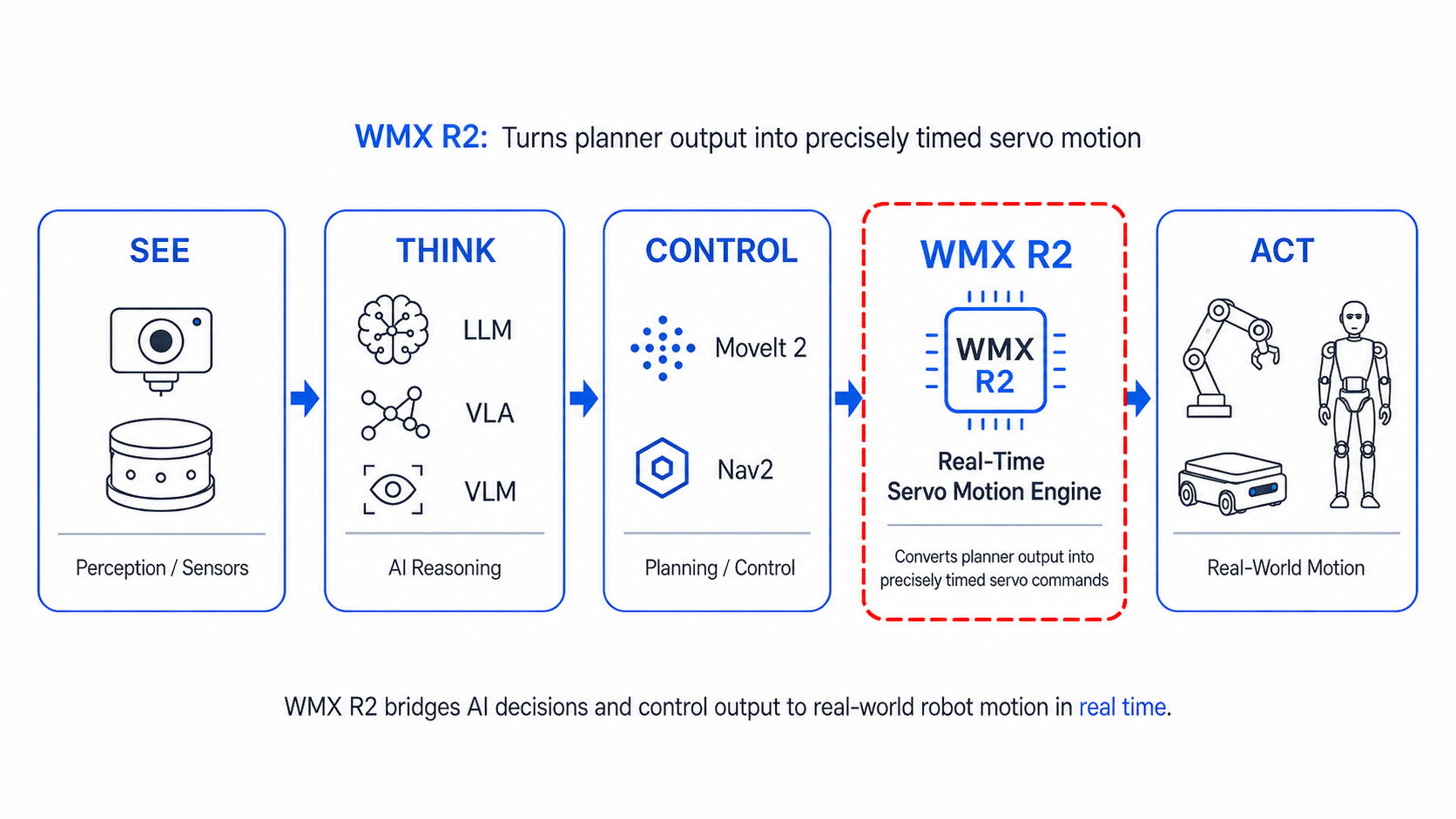
The entire stack runs on a single edge device with no separate external motion controller, combining perception and deterministic motion into edge physical AI.
WMX R2 runs on any robot or machine that uses EtherCAT.
WMX R2 integrates with widely used projects in the ROS2 ecosystem:
MoveIt2 for manipulator motion planning
Nav2 for mobile robot navigation
ros2_control for hardware interface and controller management
Intel OpenVINO for optimized inference on Intel XPU and integrated accelerators
NVIDIA Isaac Sim and Gazebo for simulation
NVIDIA Isaac ROS for NVIDIA GPU accelerated perception and control
YOLO for real time object detection
Multimodal large language models (LLMs) and vision language models (VLMs) for natural language task specification and high level reasoning
See WMX R2 in action:
To show how these pieces fit together, four companion repositories are provided as working examples and reference implementations built on WMX R2:
movensys-manipulator : manipulator scenarios with MoveIt2 / Isaac cuMotion planning and Nvblox / YOLO / AprilTag perception
movensys-navigation : a differential-drive mobile base with Nav2 planning, EKF odometry, and SLAM mapping
movensys-intelligence : a voice-driven VLM/LLM application (the Robopoly game) built on top of the manipulator stack
movensys-simulation : the Isaac Sim scenes used by the manipulator and navigation scenarios
See Example Applications to run these scenarios from start to finish.
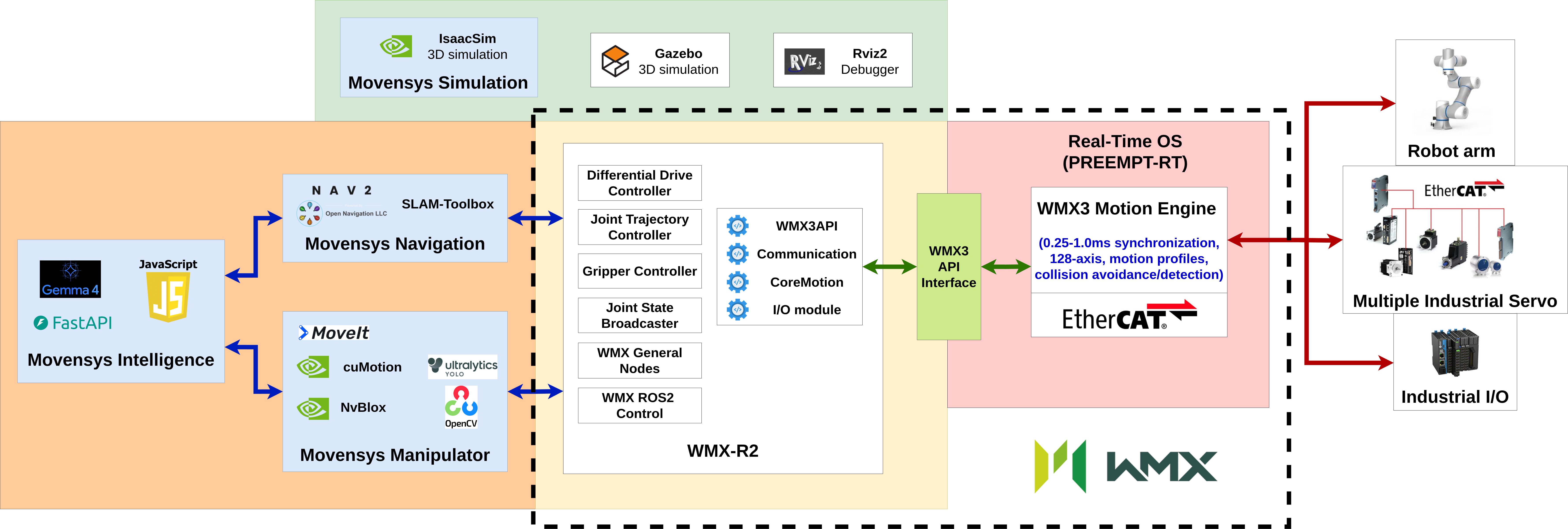
WMX R2 architecture overview.#
Any EtherCAT system, any robot#
WMX R2 runs on any robot or machine that uses EtherCAT.
WMX R2 sends commands to servo drives over EtherCAT using standard CoE. It does not go through the robot manufacturer’s controller, so it does not depend on the brand of the robot or of the drives. It controls axes rather than a specific robot model, so a six-axis arm, a differential-drive mobile base, and a custom multi-axis machine are all driven the same way.
Moving to a different robot means changing three files: the axis parameter file, the URDF, and the planning configuration. The motion engine, the ROS 2 interface, and the real-time cycle stay the same.
WMX R2 also provides general nodes for axis, I/O, engine, and EtherCAT control. You can use them to read and command any EtherCAT device on the network before writing a configuration for a specific robot.
Why WMX R2?#
A planner such as MoveIt2 or Nav2 produces a trajectory that must become the precisely timed signals servo drivers execute on a fixed cycle. Most ROS2 setups bridge this execution gap with a closed industrial controller over TCP/IP, which adds latency the planner can never recover. The other common option sends raw EtherCAT commands and leaves smoothing and coordination to ROS2, which is not built for hard real-time system. WMX R2 closes this gap by bringing the WMX motion control engine into ROS2 so planner output runs as smooth deterministic motion in one single edge device.
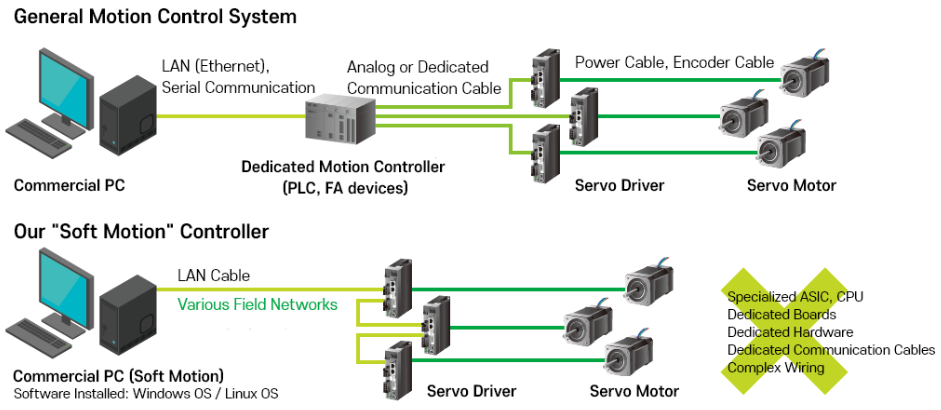
Conventional motion control routes the PC through a separate dedicated motion controller; WMX software motion drives the servo drives directly from a single edge device over the field network.#
Moving the controller into the PC removes an enclosure and its cabling, so the system is smaller, lighter, and efficient while performing better. That compact footprint suits robots and mobile machines where space and payload are tight.
WMX R2’s ROS 2 interface handles the timing-sensitive step: smoothing trajectories, coordinating joints, and emitting commands at the rate servo drivers expect. Its source code is open source under the MIT license. It runs with the WMX motion engine, which keeps motion on a deterministic cycle and exposes more than 200 APIs for trajectory conversion, EtherCAT, I/O, and engine control. The engine, its SDK, and its binaries are proprietary and require an evaluation or commercial license: the engine runs free in renewable 6-hour sessions that you extend by restarting it, and a commercial license removes the limit for production.
Performance comparison#
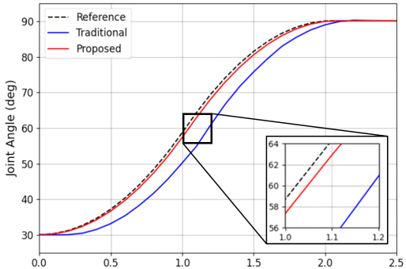
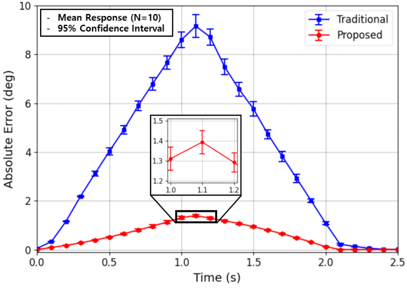
We executed the same trajectory ten times. The left panel shows a representative run, and the right panel presents the per-sample mean absolute tracking error (MAE). The overall MAE corresponds to the time average of this curve. WMX R2 reduced the MAE by 85% relative to the conventional external controller, thanks to lower communication latency from removing the TCP/IP hop and a redundant control stage.
Customers and Partners#
The WMX motion engine has a long, proven industrial track record:
25+ years of development with 40+ patents worldwide
40,000+ cumulative licenses sold
500+ customers, mainly in the semiconductor industry
Where to go next#
Follow the Getting Started guide to set up the environment and run the package.
Work through the Example Applications to run trajectory, perception, and intelligence demos.
See Integration Scenarios for the supported motion-planning and application integrations.
Work through Commissioning before moving a physical robot; parameter validation, first motion, safety responsibilities, and the list of validated robots.
Refer to the API Reference for ROS2 services, topics, and actions.
Consult Support for common issues and their resolutions.
Read Licensing for the boundary between the MIT-licensed ROS 2 interface and the proprietary WMX motion engine.
- Getting Started
- Example Applications
- Integration Scenarios
- Commissioning
- API Reference
- Support
- Troubleshooting
- Robot Moves in the Wrong Direction
- Robot Moves the Wrong Distance
- Wrong Joint Moves
- All Joints Offset by a Constant
- Device Creation Failures
- EtherCAT Scan Failures
- Communication Start Failures
- Joint States All Zero
- Servo Alarm Errors
- Trajectory Execution Failures
- Gripper Not Responding
- Nodes Not Found
- Build Errors
- Getting Help
- Troubleshooting
- Licensing
- About Us